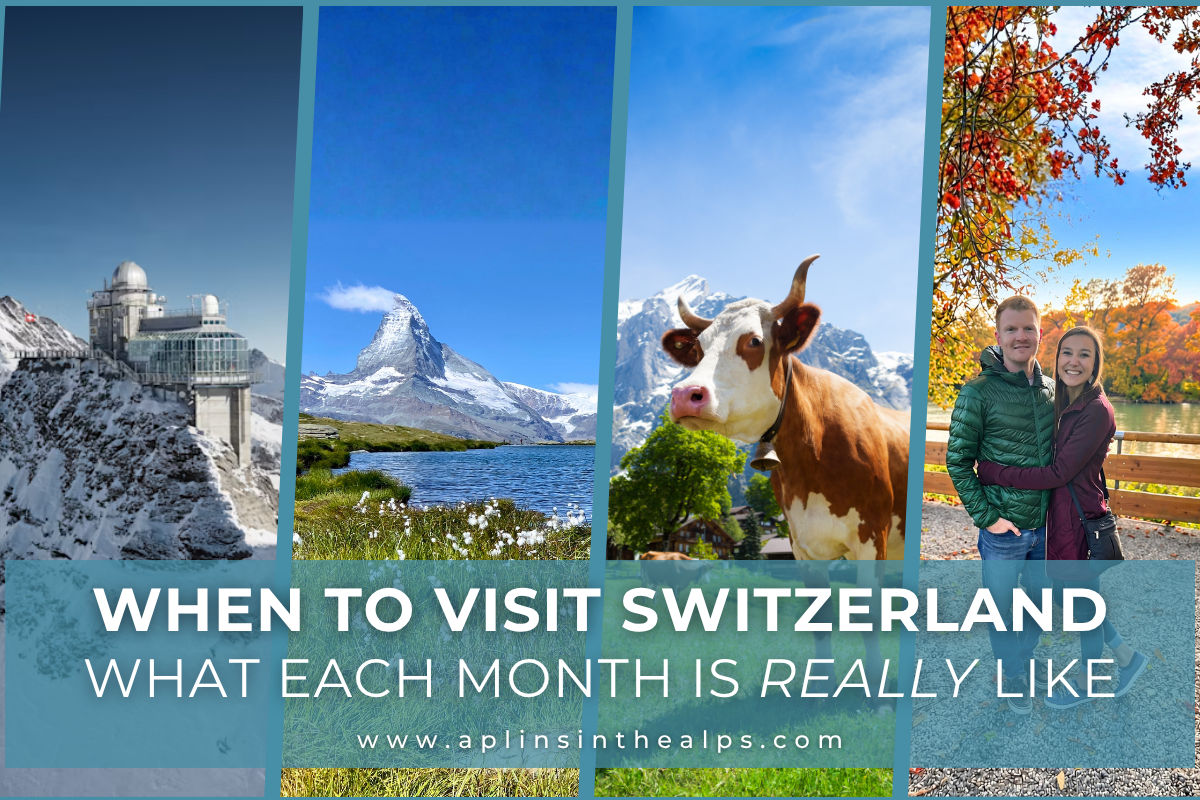
When is the best time to visit Switzerland? The answer isn’t as simple as you might think.
So instead of just telling you the best time for hiking or mountain attractions or autumn leaves or skiing, we’re going to walk through every season of the year and tell you exactly what each one is best for, what might disappoint you, and what changes from month to month.
Because there isn’t one best time to visit Switzerland. There’s only the best time for the kind of trip you want to have.
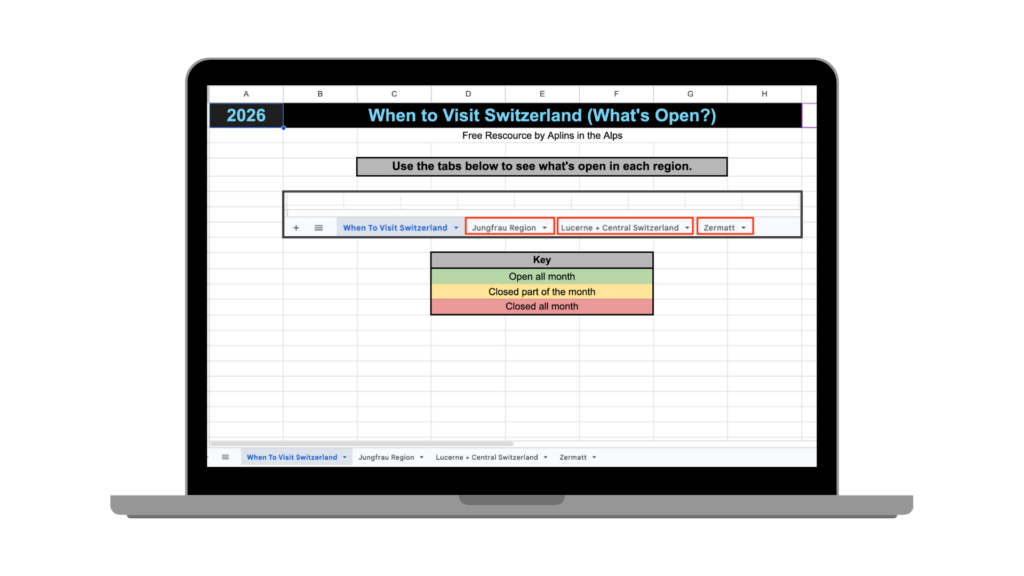
Grab the FREE Spreadsheet
When To Visit Switzerland Month-by-Month
One important note: Switzerland doesn’t flip from season to season on a specific date. Weather and seasonal opening times vary widely, especially in the mountains, so use our info as general guides rather than guarantees.
And I know it’s not very Swiss to start in the middle, but most of you plan a trip in the Summer or shoulder-seasons, so we’re going to start with Spring and end with Winter.
Want to Watch instead of Read?
April–May: Spring in Switzerland
A Swiss vacation in Spring might just be the most beautiful time of the entire year. And it should be amazing — at lower elevations. Things get a bit more complicated higher in the mountains.
For example, we took the train to Wengen this past April and we hardly saw anyone in town. We even hiked all the way down to Lauterbrunnen without another hiker. It was amazing! But that was largely because most of the hotels, restaurants, and cable cars were closed. That’s Spring in the Swiss Alps!


Spring in Switzerland is best for…
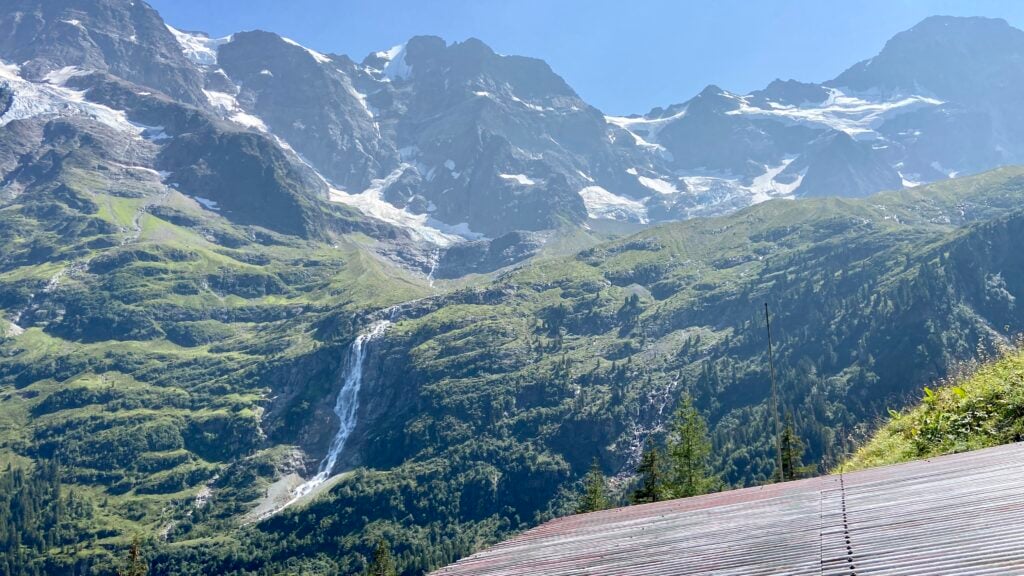
When you picture Switzerland in your mind, you might be imagining the classic beauty of a Swiss Spring. Think green meadows, blooming flowers, gushing waterfalls, snowcapped mountains, and beautiful lakeside towns. It’s also a great time for scenic train rides and city sightseeing.
And some extra perks are fewer crowds and less heat. But there are drawbacks as well.


Watch out for…
Spring is often better for looking at the mountains than being high up in the mountains.
That’s because many mountain attractions, hotels, and restaurants have seasonal closures anywhere from 1 week to 1 month or even longer.
And Spring isn’t ideal for high alpine hiking because many trails are still snow-covered or closed due to avalanche risk. Plus, the weather can be unpredictable. Perfectly sunny one day, rainy another, and maybe even a dusting of snow overnight.
Spring in Switzerland Month-by-Month
Let’s break it down a bit further with a month-by-month look.
April is the most transitional month throughout the country. It’s spring in the cities but still muddy and semi-Wintry in the mountains. And some mountain attractions may be closed for most of the month. Also note that Easter and school breaks bring more crowds.
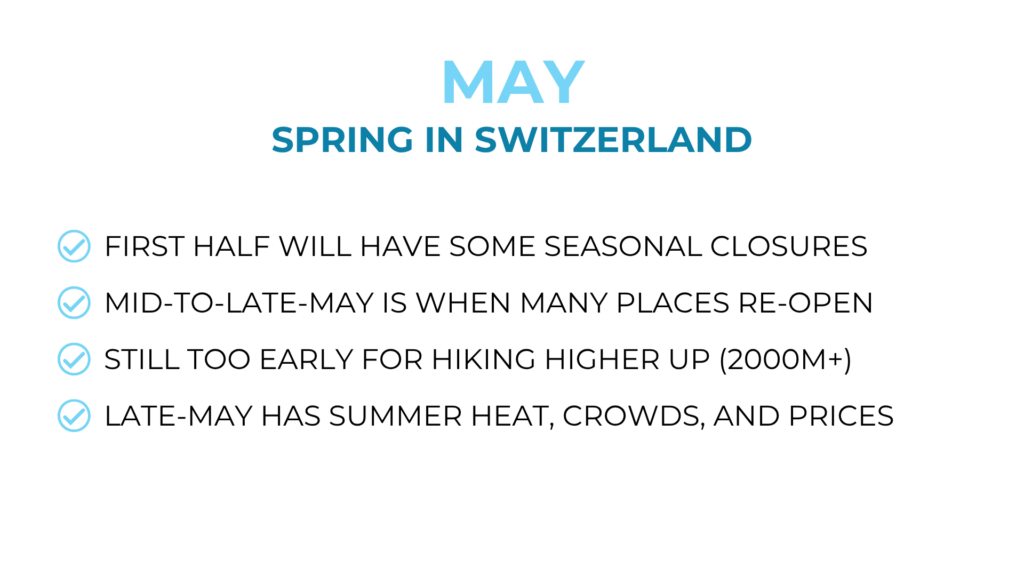
The first half of May will still have lingering seasonal closures too. But mid-to-late-May is when many places re-open. Yet this is often still too early for hiking higher up in the mountains (think 2000m and up). By the end of the month, though, you’ll notice Summer heat, crowds, and prices starting to return.
Bonus tip for flower lovers: look into the Tulip Festival in Morges or the Narcissus blooms near Montreux during this season!
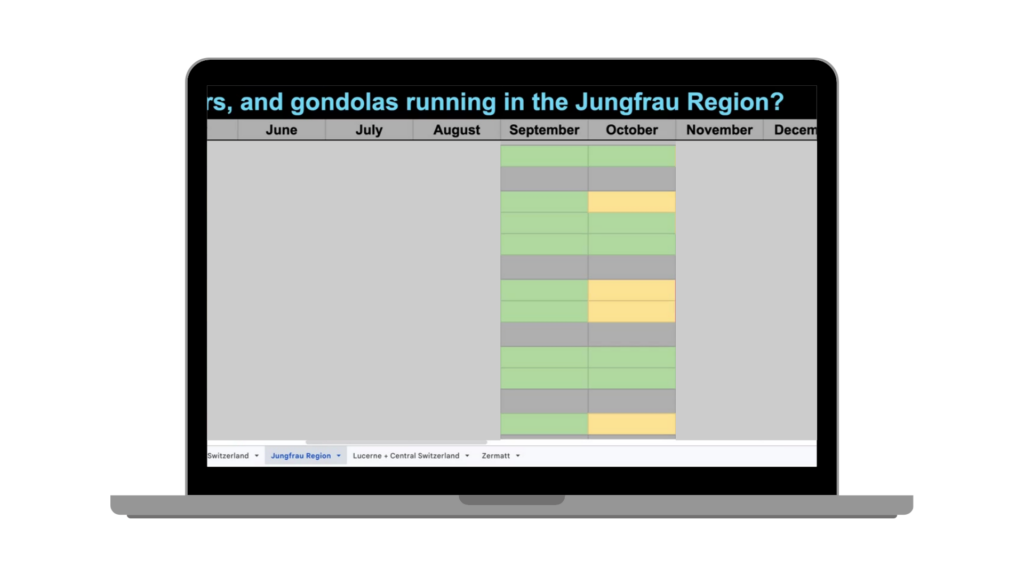
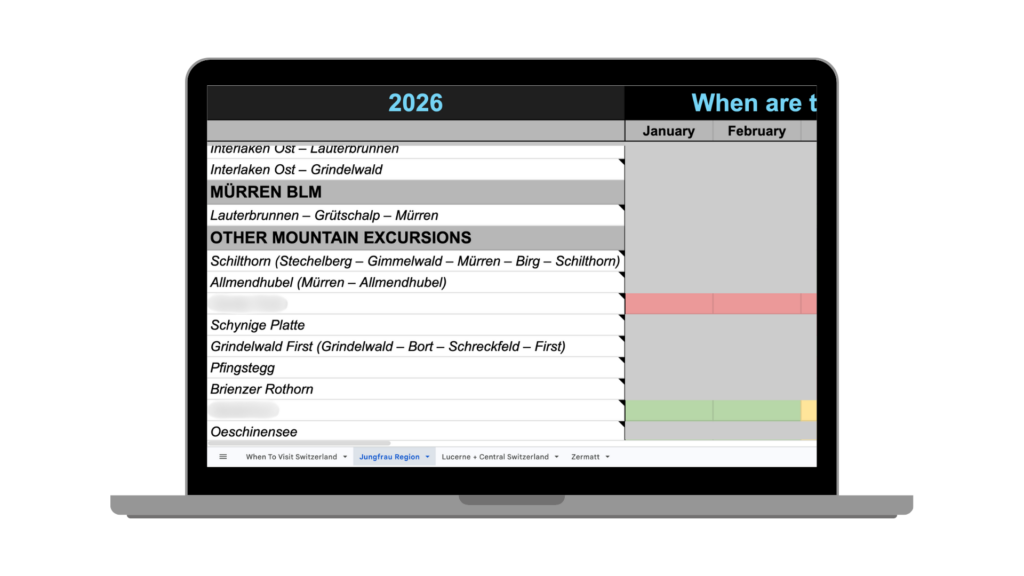
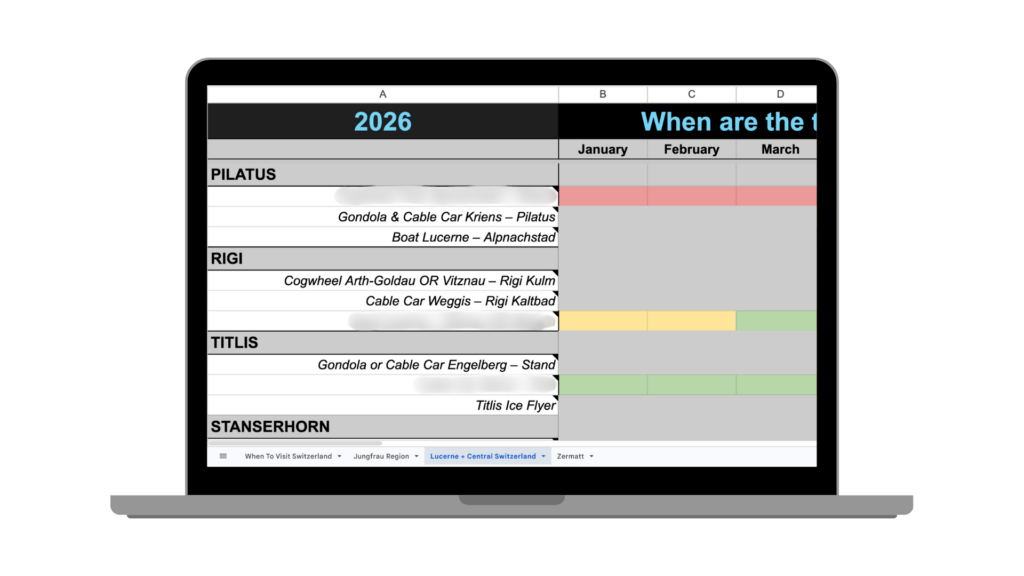
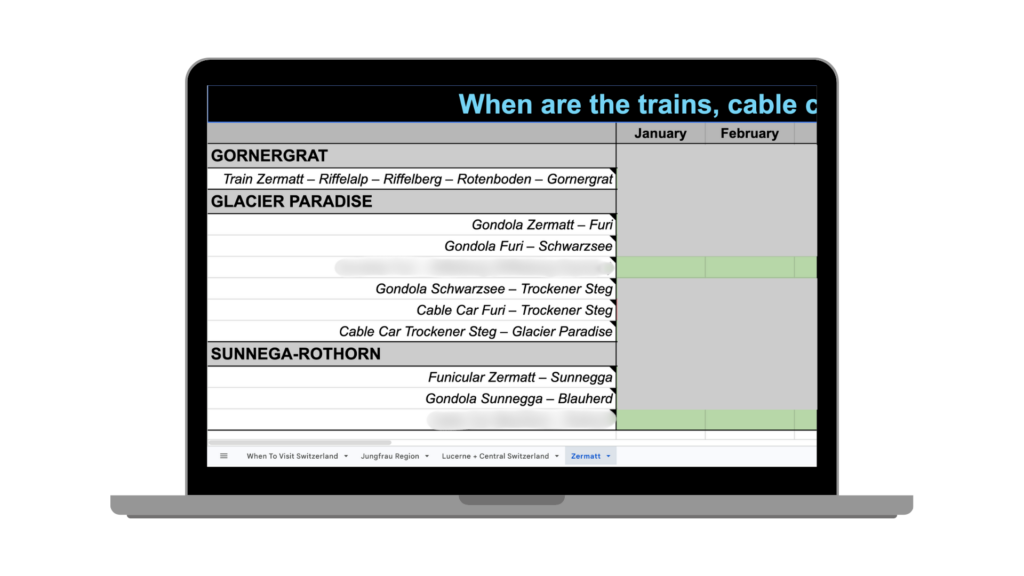
Let’s say you’re planning a trip in late-April or early-May and want to know what will be open or closed. Using our free spreadsheet, just scan the columns for an instant answer. You can see at a glance when the major mountain attractions, scenic trains, and other popular activities are open throughout the year.
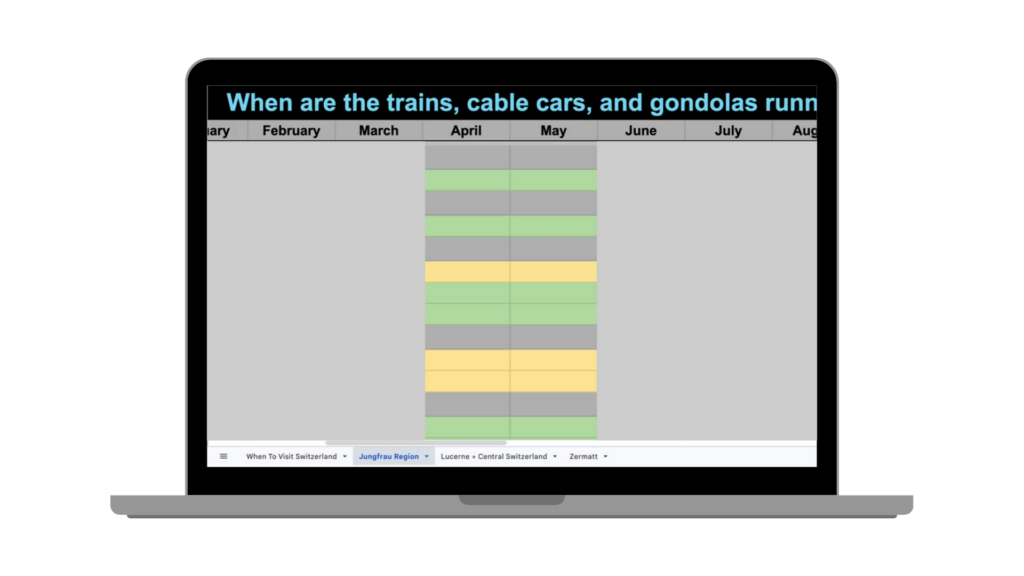
So if you’re traveling in late April and wondering, “Can I actually do this?” you don’t have to guess, thanks to this free spreadsheet.
So, to wrap up this season, you’ll be disappointed if you take your Summer itinerary and move it to April, hoping to beat the heat and the crowds. Instead, Spring in Switzerland requires flexibility but delivers endless beauty.
June–August: Summer in Switzerland
Ahh, I love Summer in Switzerland. Sunshine and long days. Boots on the trail, feet in the lake, picnics in the park. It’s my personal favorite season, and it’s also when most of you will be enjoying your Swiss vacation.
This is the best choice for first-time travelers who want maximum access and the iconic Swiss Alps experience — but it is also the season where poor planning gets punished the most.
Summer in Switzerland is best for…
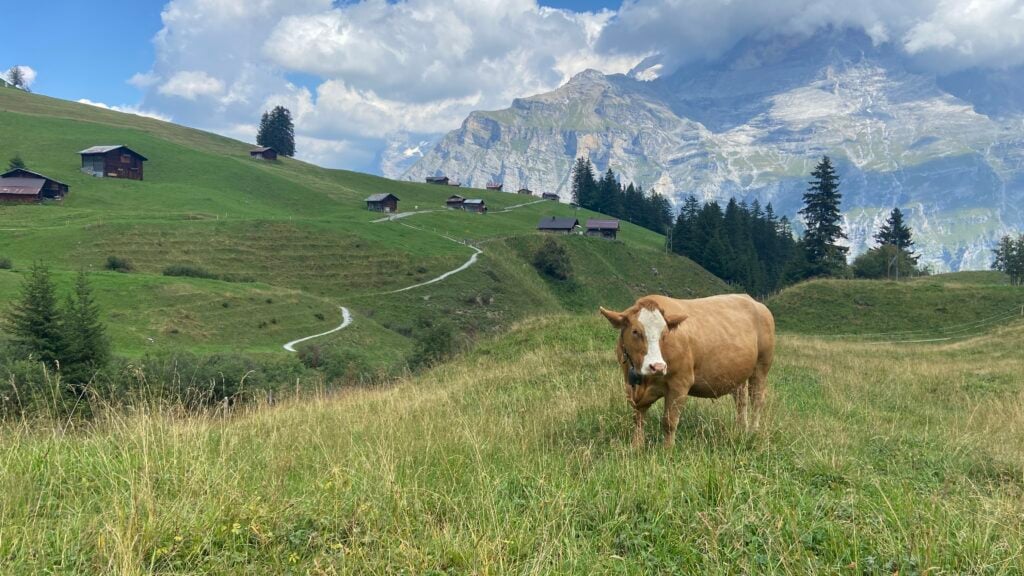
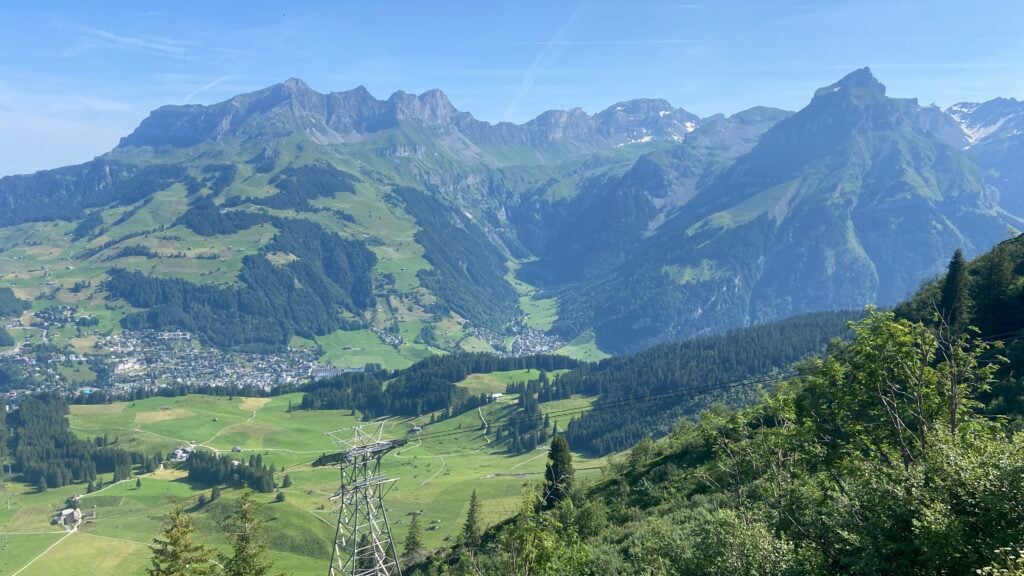
The good news is, almost everything is operating, the days are long, waterfalls are full, cows are grazing, hiking trails are accessible, playgrounds are open, and lakes are swimmable.




Watch out for…
But here’s the problem in Summer: everyone wants the same things at the same time.
You can’t avoid the packed trains, crowded viewpoints, booked hotels, and full restaurants. Popular activities like paragliding or museums may require reservations or even sell out. And that higher demand often drives higher prices in this season.
And you can’t avoid the heat. Cities can feel stifling, scenic trains feel like an oven with those big panoramic windows, and the sun feels even stronger when you’re up in elevation. Plus air conditioning is just not very common, or even that cold. So be prepared to sweat more and be surrounded by other stinky travelers.
Our biggest summer cheat code is to get out earlier. You’ll have cooler temperatures, fewer crowds, and better weather in the mornings — and a better experience before everyone else arrives.
Summer in Switzerland Month-by-Month
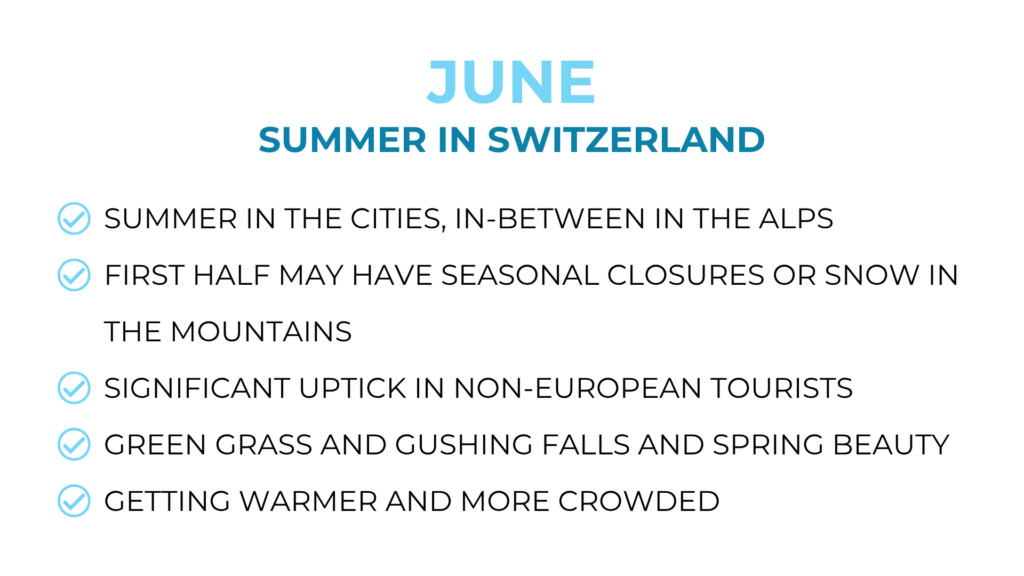
June feels like Summer in the cities, but an in-between season in the Alps. The first half of the month may still have some seasonal closures in the mountains, and even some snow-covered trails, but most of that will be resolved by the middle of the month. And you’ll notice a significant uptick in non-European tourists since most European schools are still in session. There will be green grass and gushing falls and lingering Spring beauty, but it’s also getting warmer and more crowded.
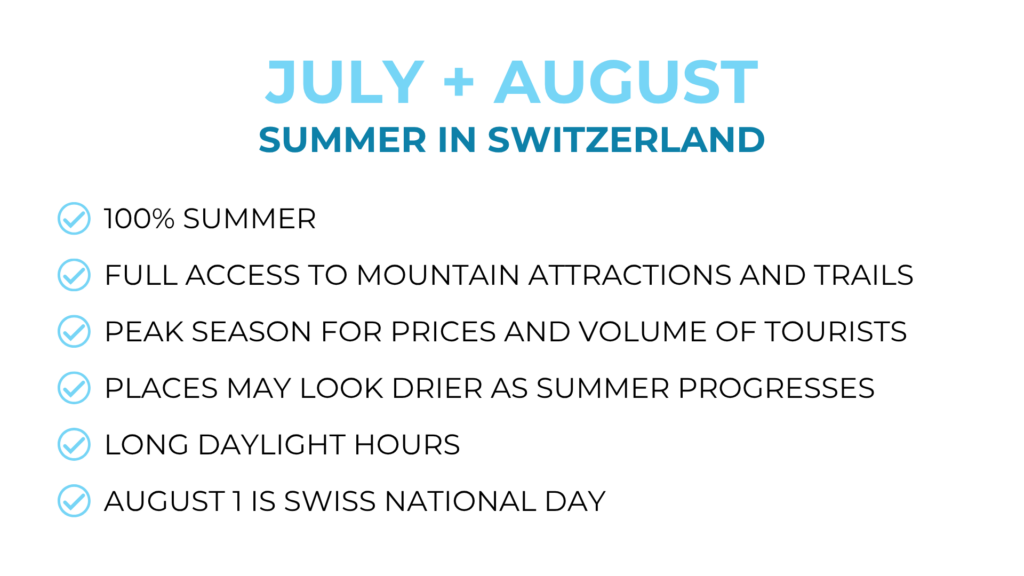
July and August are 100% Summer. You’ll have full access to mountain attractions and higher trails. It’s the peak season for prices and volume of tourists. Depending on heat and rainfall, places can start to look a bit drier as the Summer progresses. But long daylight hours mean you can truly spend the whole day outside.
And don’t overlook August 1, which is Swiss National Day! If you’re here, you’ll find loads of fireworks, parades, music, and cultural events — and Swiss tourists too
So in general, Summer in Switzerland gives you the most complete experience, but it also comes with the highest demand.
September–Mid October: Early-Autumn in Switzerland
Early-Autumn may be the best all-around time for many travelers. In fact, if you ask me for my favorite season in Switzerland, this one tops my list. You still get most of the Summer access, but with less tourists, cooler temperatures, and lower demand.
Early Autumn in Switzerland is best for…
The sky just looks bluer and the air is crisper. You can tell Winter is coming, but it’s also still clinging to Summer. Most mountain attractions and hikes and scenic train rides are still fully open. Plus, most kids are back in school around the world so there are fewer people traveling.



Watch out for…
It’s important to distinguish that earlier in this season gives you more margin than later. Most mountain transport will be shutting down by the time this season ends.
The landscapes are starting to change to more browns than greens. And with less water in the streams and waterfalls, it may not have the classic look you’re expecting.
The days are getting shorter and we’ve even seen some early snows in the mountains in mid-September. It’s unlikely to stick around, but even just an overnight dusting might limit your hiking options.
And finally, cooler mornings and evenings mean you’ll definitely want to pack more layers in your suitcase.
Early Autumn in Switzerland Month-by-Month
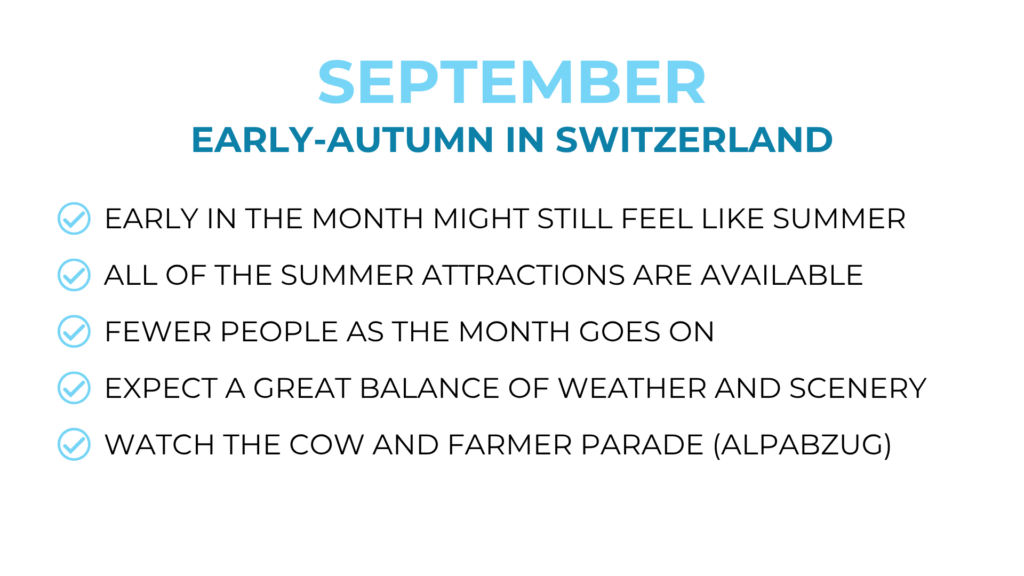
September is ideal. Early in the month might still feel like Summer with higher temperatures and crowds. But with very few exceptions, all of the Summer attractions are available with fewer people as the month goes on. In general, you can expect a great balance of weather and scenery. If you’re here in September, see if you can watch the parade of cows and farmers descending from the alps back to the valleys.
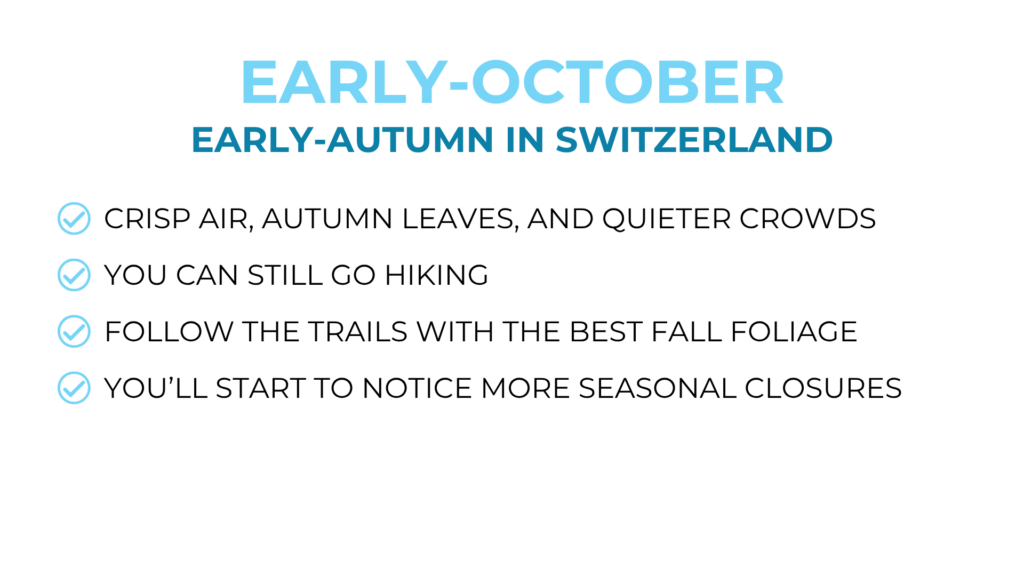
Early-to-mid-October delivers crisp air, autumn leaves, and quieter crowds. You can still go hiking depending on the weather, and you might want to follow the trails with the best Fall foliage. But this season is when you’ll start to notice more seasonal closures.
Early-Autumn may be the best overall window for many travelers: still beautiful, still active, but calmer than Summer.
Mid-October–Late-November: Late-Autumn in Switzerland
If early-Autumn is ideal, then late-Autumn is the exact opposite. This is one of the most limited seasons for a classic sightseeing trip.
Late-Autumn in Switzerland is best for…
Late-Autumn in Switzerland is best for trips to cities and museums, spas and restaurants, or just quiet travel in general. It has fewer tourists and some of the lowest prices of the year.





Watch out for…
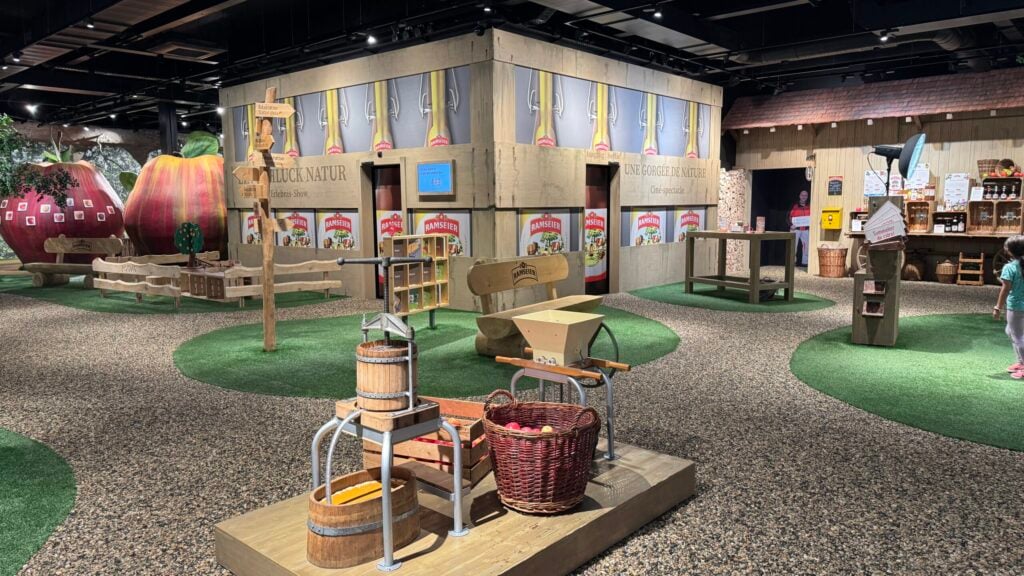
While it’s a great time at lower elevations, this is a less-than-ideal time for a trip focused on the Alps. Loads of restaurants, hotels, mountain transport, and trails may be closed or offering limited services.
You might not see either Summer or Winter scenery, just a bland in-between.
The weather is often cold, wet, and unpredictable. You’ll want to watch the forecast and the webcams. There’s this fog that settles in the valleys this time of year, covering them in perpetual gray. You can go up in the mountains to get above the fog, but it’s not always easy to get up that high during this season due to annual maintenance closures.
Late Autumn in Switzerland Month-by-Month
Mid-to-late-October can still be beautiful with red, green, and yellow leaves — but that’s highly dependent on the weather. You’ll need to check more carefully which transport lines, trails, hotels, and restaurants are open. By the end of the month, the whole country feels like it’s shifting toward the end of Autumn.
November is quite possibly the least appealing month to visit the Swiss Alps, although it’s good for cities, museums, spas, and food. It will be quiet and cheap, but probably won’t blow you away with the classic Swiss beauty.
One very Swiss reason to visit in this season is for Wild Game nights. Local restaurants serve dishes with freshly hunted rabbit, deer, chamois, and wild boar. If you are a foodie, you won’t want to miss these delicacies!
Late-Autumn is less about checking off Switzerland’s famous attractions and more about enjoying the cities and year-round museums, despite the weather.
Late November–December: Holidays in Switzerland
Late-November through December is the holiday season in Switzerland. Come for the cozy vibes, but don’t expect guaranteed snow.
Late-November and December in Switzerland are best for…
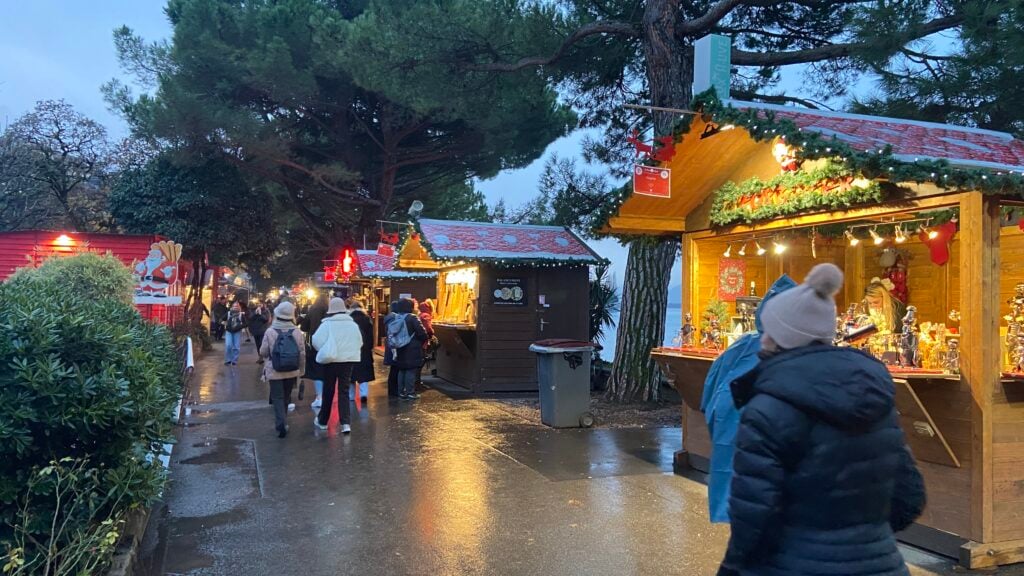
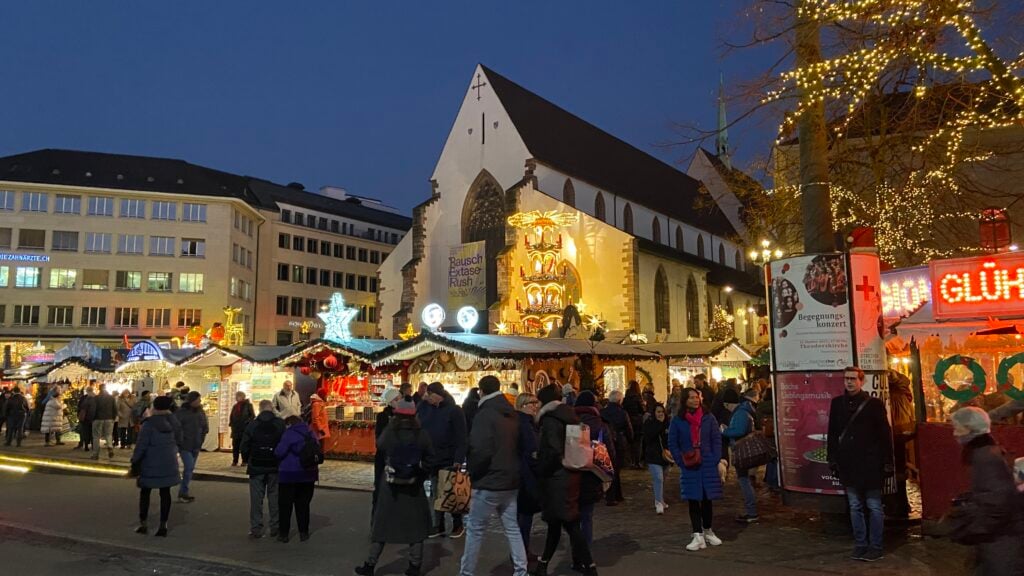
These months are best for Christmas markets of course! Squares and parks transform into Wintry scenes, and many cities and villages set up special seasonal experiences. You can easily explore cities, museums, and enjoy scenic train rides.




Watch out for…
But make note of the weather. There’s less daylight, which means Christmas lights start twinkling by 4:00pm and some places might close early in the evenings. And if you’re expecting snow, you might be disappointed — even in the mountains.
Late-November and December in Switzerland Month-by-Month
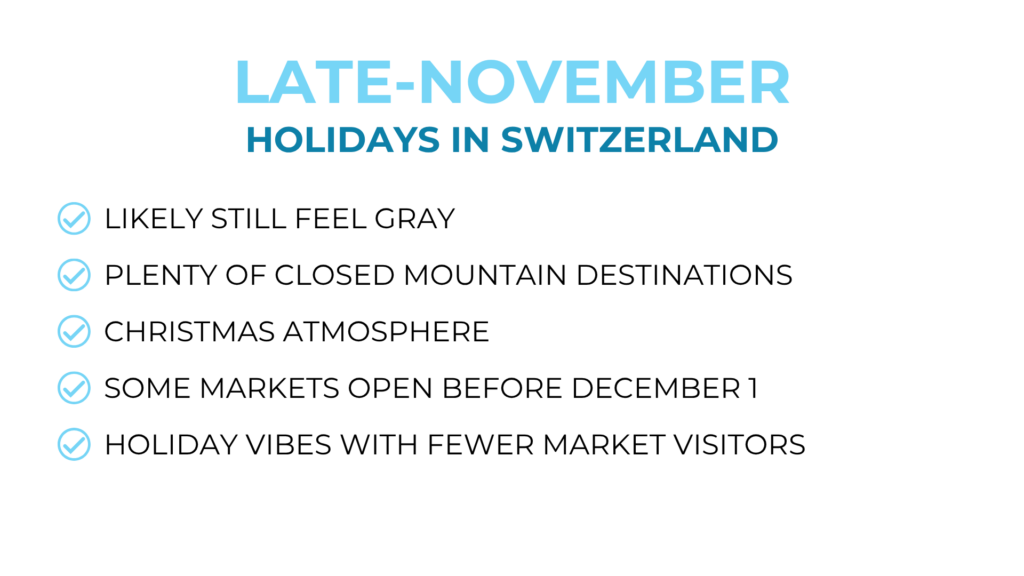
Late-November will likely still feel gray and have plenty of closed mountain destinations. But the Christmas atmosphere pops up later in the month since many of the biggest markets open before the calendar hits December first. So the last week of November could be a great time to visit for holiday vibes with fewer market visitors.
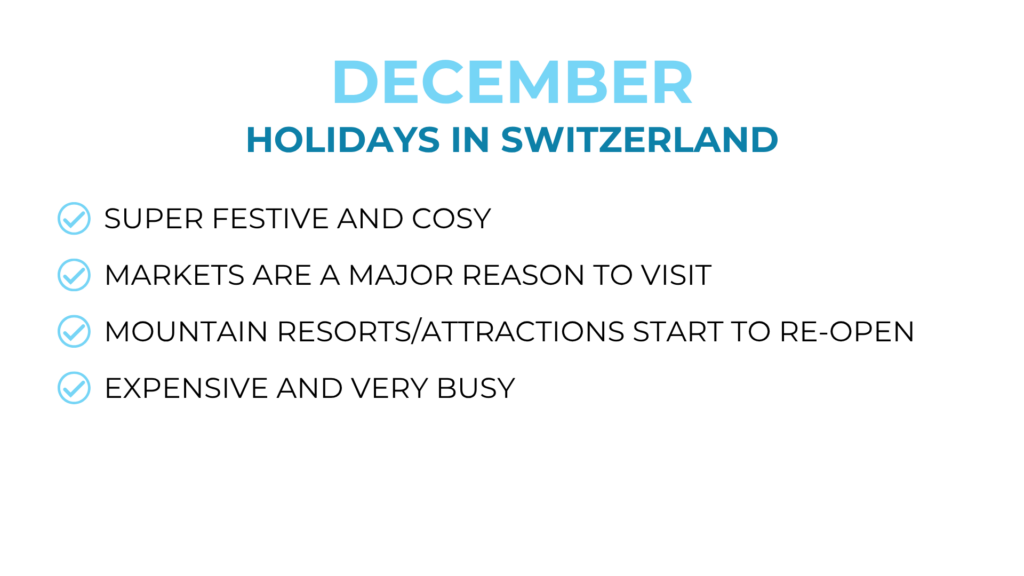
December is super festive and cosy. The markets are one of the major reasons to visit, although many mountain resorts and attractions also start to re-open by the middle of the month. But as you can imagine, Christmas through New Years is an expensive and very busy time to visit Switzerland.
December is not just winter — it’s holiday Switzerland in full swing. Come for the charm and atmosphere, but do not assume it will be a snowy white wonderland yet.
January–March: Winter in Switzerland
The holiday atmosphere might be over once we reach the new year, but Winter in Switzerland is great for snow activities and scenic trains. Maybe you’re hoping to take your Summer itinerary and plop it into Winter — but you might want to think again.
Winter in Switzerland is best for…
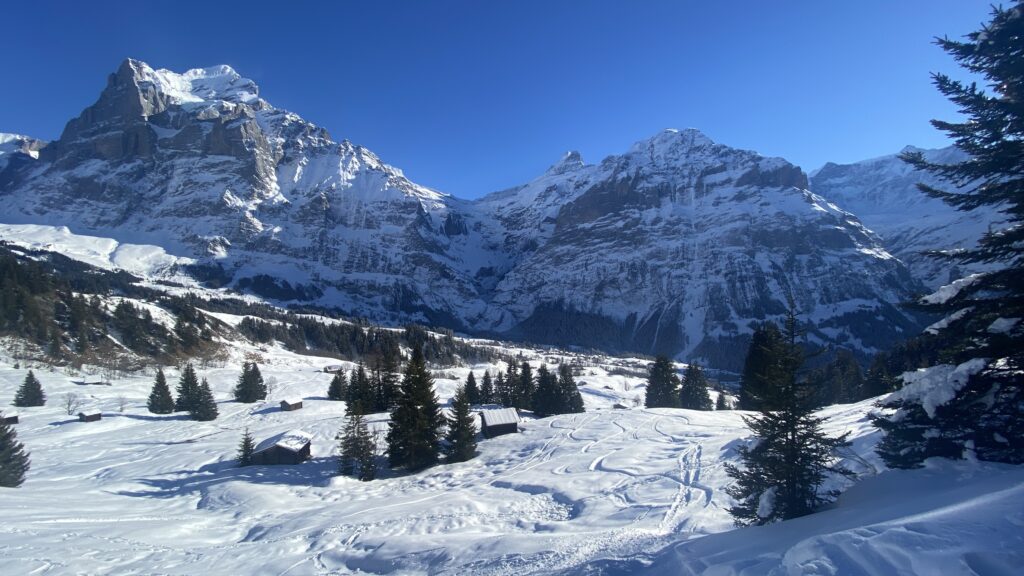
Winter in Switzerland is best for snow and Winter sports! There are endless mountain resorts, ski pistes, sledding runs, and Winter walking trails.
The cities feel surprisingly quiet. It’s easy to do some sightseeing before popping inside a shop or cafe to warm up. And while prices are higher in mountain resorts, the cities aren’t as expensive this time of year.
Plus, you can take in the snowy landscapes from the warmth of a scenic train like the Glacier Express or Bernina Express.

Watch out for…
Reality check: not every town or valley is snow-covered. For example, we live near Interlaken, and we usually only have snow on the ground for a handful of days each Winter. So if you want snow, you have to go higher in elevation.
And to go higher, you’ll have to ride the trains. Which will be packed with skiers and all their gear, ready to hit the slopes. This is one benefit of finding mountains to visit that aren’t also ski resorts, like Mt. Pilatus.
In contrast, lower elevations can be wet and cloudy. The waterfalls are fed by snowmelt, and since snow is mostly still accumulating, they’re not super impressive. And even the valleys aren’t very green right now.
And some tourist attractions and boat rides are closed or limited in Winter.
In general, less daylight and shorter museum opening times shrink your sightseeing window.
Winter in Switzerland Month-by-Month
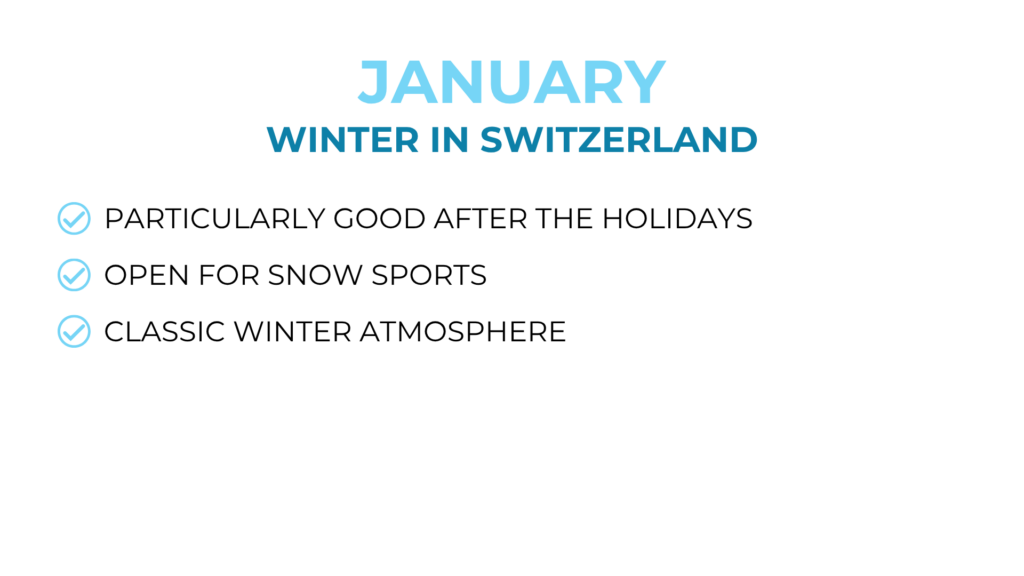
January is particularly good after the Christmas and New Year rush. It’s open for snow sports and is great for anyone looking for a classic Winter atmosphere.
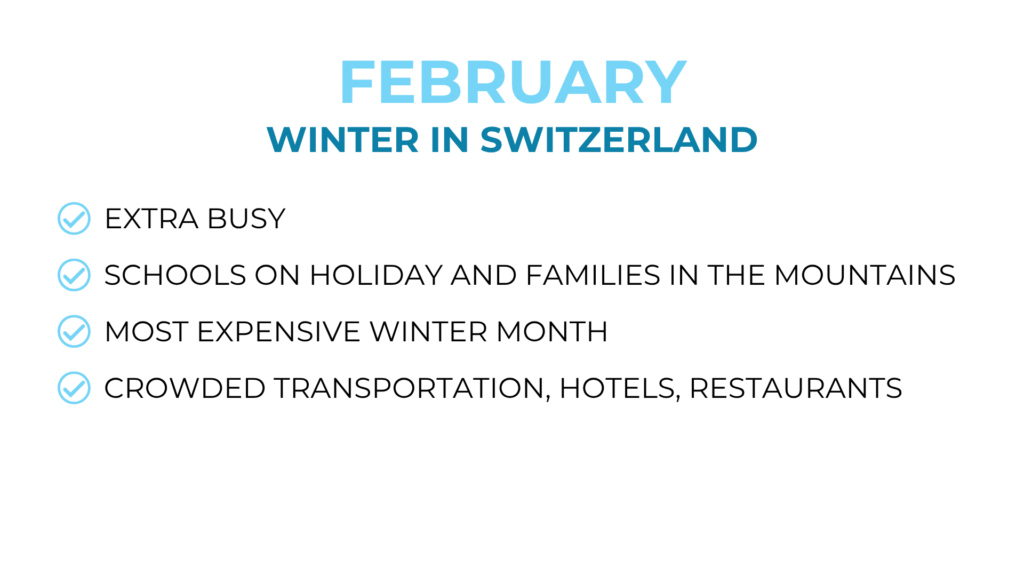
February is also like that, but extra busy. Schools throughout the country go on holiday, so families flock to the mountains, making February the most expensive Winter month. Even if you’re not a skier, you’ll experience the crowds on transportation, and in hotels and restaurants.
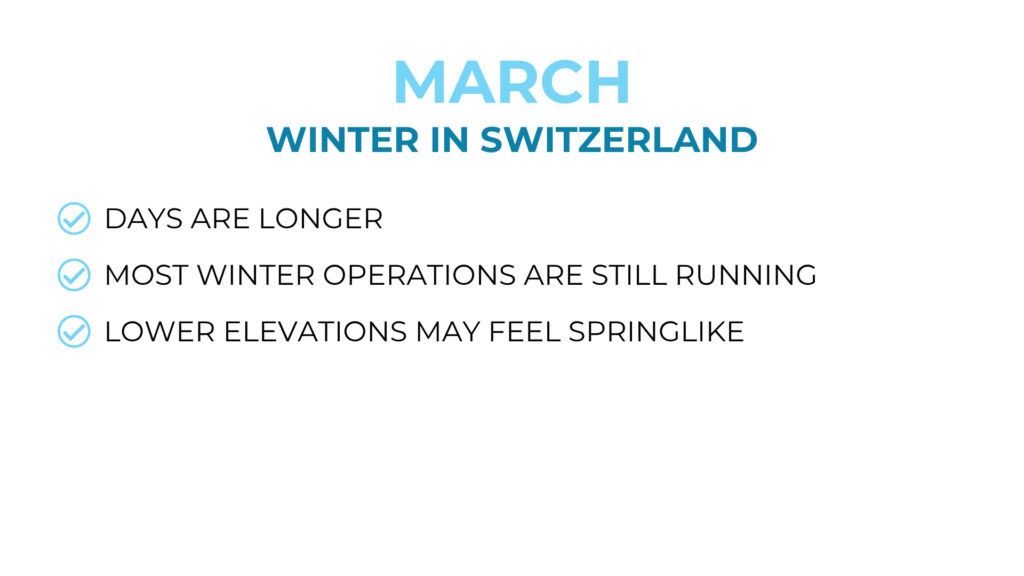
But March can be a nice compromise because the days are longer, most Winter operations are still running, and lower elevations may start feeling more springlike.
And if you’re here during Carnival, also called Fasnacht, you can find the most famous festivals in Basel or Lucerne.
So a Winter trip is awesome if you’re looking for a classic snow holiday. But it’s not the same as a Summer trip with snow added.
When to Visit Switzerland
So there’s not a single best time to visit Switzerland. There is only a best time for the kind of trip you actually want.
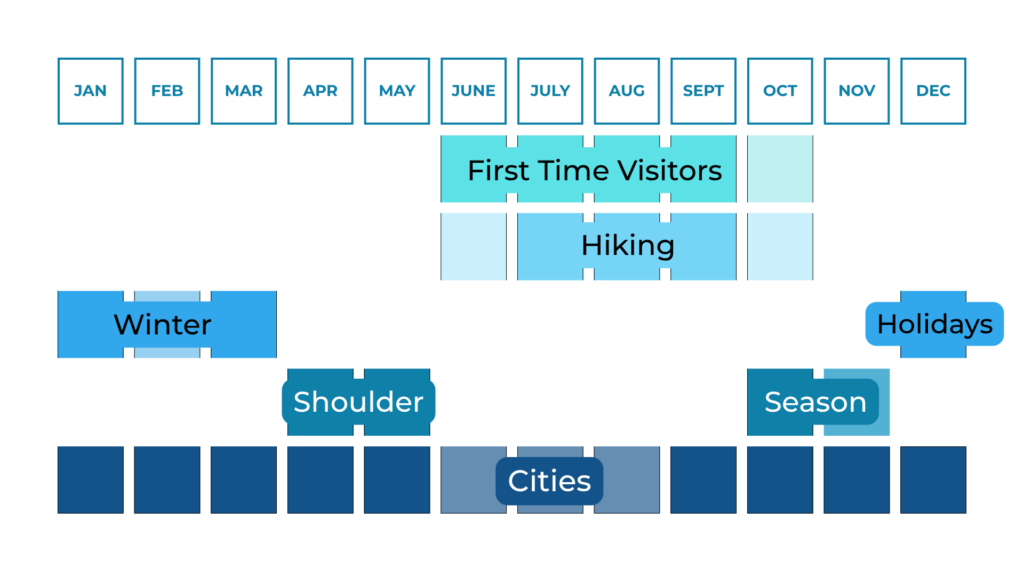
Our free spreadsheet shows you exactly what mountain attractions and transportation lines are open month-by-month.
So now that you know when you want to go, the next question is:
- Where to go?
- What to do once you’re there?
- How to get there?
- Or how to put all of it together into a cohesive itinerary?
That’s what our Swiss Travel Guides are designed to do. So grab both of those — the spreadsheet and the Guides — and we’ll see you in Switzerland!